
Clear Thinking Essentials
A 36-week logical fallacies curriculum for families. Discovery-first, conversation-led, and built to respect your kid's intelligence and your time.
The Future is looking bright
- By week four, they spot their first fallacy in a TV commercial or book.
- By week twelve, they're using terms like "begging the question" without prompting.
- By week twenty-four, arguments are shifting away from emotion.
- By the end of the year, they've learned a new way of thinking, not just a vocabulary.
$34.00. Instant PDF download. 36 weekly lessons.
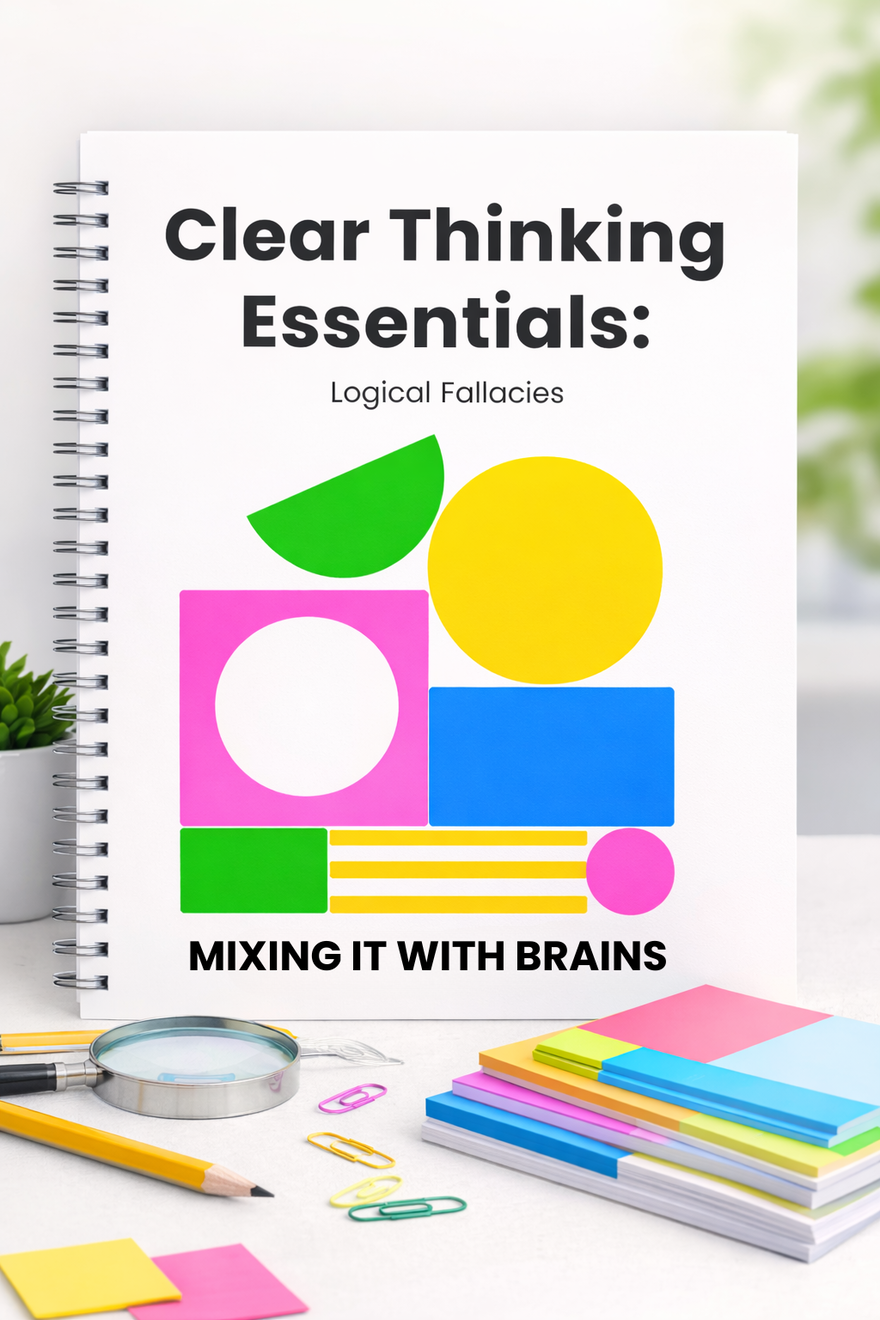
Zero Prep Journey into Critical Thinking.
Students discover fallacies through real-world scenarios before learning definitions, making concepts stick naturally. Then they learn the proper academic term, including Latin pronunciations. (We don't dumb it down.) They understand why people use this faulty reasoning, analyze a second example, and demonstrate mastery through narration. No worksheets, no busywork, just genuine understanding through narration and discussion.
Immersive Assessments.
Rather than traditional multiple choice questions, our assessments immerse students in realistic dialogues where they must identify faulty reasoning as it naturally unfolds in conversation. This mirrors our ultimate goal: helping students recognize bad logic in debates, advertisements, and everyday disagreements.
Each assessment builds confidence through progressive complexity, starting with focused practice and expanding to more comprehensive reviews that gauge their ability to spot fallacies woven naturally into real conversations. We're replacing busywork with discussion starters that help you guide your student through the "why" behind each fallacy, reinforcing understanding and building critical thinking skills that last a lifetime.
What to expect inside.
Spot the faulty logic.
Students read a real-world scenario and try to identify what's wrong before they learn anything. Discovery first.
Learn the fallacy.
The proper academic name (Latin pronunciations included) and a clear definition. Respect for your child's intelligence.
Understand the why.
Why people use this fallacy, when they're likely to encounter it, and exactly where the reasoning breaks down.
Narration
A second example reinforces the concept. Students narrate what they've learned and create their own example, the Charlotte Mason way.
Good Questions, Frequently Asked
What ages is this written for?
The curriculum is written to be accessible for students as young as 10, but families have used it successfully all the way through high school. The examples are drawn from everyday life, so they land well across a wide age range. Older students especially enjoy the deeper discussions, and plenty of parents have told us they're learning right alongside their kids.
How is each lesson structured?
Each lesson follows a four-step discovery flow. First, your student reads a realistic scenario and tries to identify what's wrong with the reasoning, before they learn anything. Then they meet the fallacy by name and definition. Next, they learn why people use it and where it breaks down. Finally, a second example reinforces the concept and they narrate it back in their own words and create their own example. The discovery-first approach is why these concepts actually stick.
How much time does each lesson take?
Most families spend about 10 to 15 minutes per lesson, depending on how deep the discussion goes. Some keep it quick as part of a morning basket. Others let it turn into a longer family conversation. There's no pressure either way.
What kind of assessments are included?
No multiple choice. Students identify fallacies in realistic conversations, just like they'll need to do in real life. Short assessments come every four lessons, with cumulative reviews every twelve. Complete answer keys with detailed explanations are included, and they double as discussion starters.
Do I need a background in logic to teach this?
Not at all. The curriculum is completely open-and-go. Everything you need is on the page: the scenario, the definition, the explanation, and the answer key. Many parents tell us they've never studied logic and they're picking it up just as naturally as their kids are.
Will my kids need to do a lot of writing?
No. Most of the work is reading and discussion. Students narrate what they've learned in their own words (a Charlotte Mason hallmark) and create their own examples, but the curriculum is designed to be more spoken than written, especially for younger students. You can flex it up or down depending on your child's comfort with writing.
Can I use this in a co-op setting?
Absolutely. The lesson structure works well for group discussion, and the assessments are great for collaborative learning. You could easily assign the initial scenario as a group activity and let the discussion unfold from there.
Is this a specifically Christian curriculum?
It's designed with Christian homeschool families in mind, and some examples touch on faith-related conversations, but the logic skills themselves are universal. Any family that values critical thinking and wants to protect their kids from manipulation will find this useful.
What if my student struggles with a lesson?
That's completely normal and actually part of the design. The lessons are sequenced from simple to complex, and the discovery approach means students are supposed to wrestle a bit before the answer is revealed. If a fallacy doesn't click right away, the cumulative reviews circle back to reinforce earlier concepts. Progress, not perfection, is the goal.
Can I see a sample lesson before buying?
Yes. Lessons 1, 2, and the first Logic in Practice are free to download. You'll see exactly how the structure works, the tone of the writing, and the kind of conversation it sparks before you commit.