
Raise critical thinking kids.
The world is loud, fast, and full of bad arguments. Cancel culture, fear-based politics, outsourcing our thinking to AI, peer pressure that lives in your kid's pocket. You can give them something better. Real conviction grounded in real thinking. And you don't have to have it all figured out yourself to start.

You want kids who can think for themselves. Not contrarians. Not cynics.
Kids who can pause, weigh what they hear, see through manipulation, and hold convictions because they've actually thought them through. The kind of kids who don't fold when the room turns against them, because what they believe is genuinely theirs.
Most kids won't be ready. Yours can be.
Critical thinking is built in small, repeated moments. In the car. On a walk. At dinner. The questions you ask in response to what your kids say, repeated over months and years, are what shape how they think. Starting sooner gives them the on ramp they need.
Slowly, those questions move them from emotionally invested beliefs to reasoned convictions. From kids who absorb whatever the loudest voice tells them, to kids who can do their own thinking.
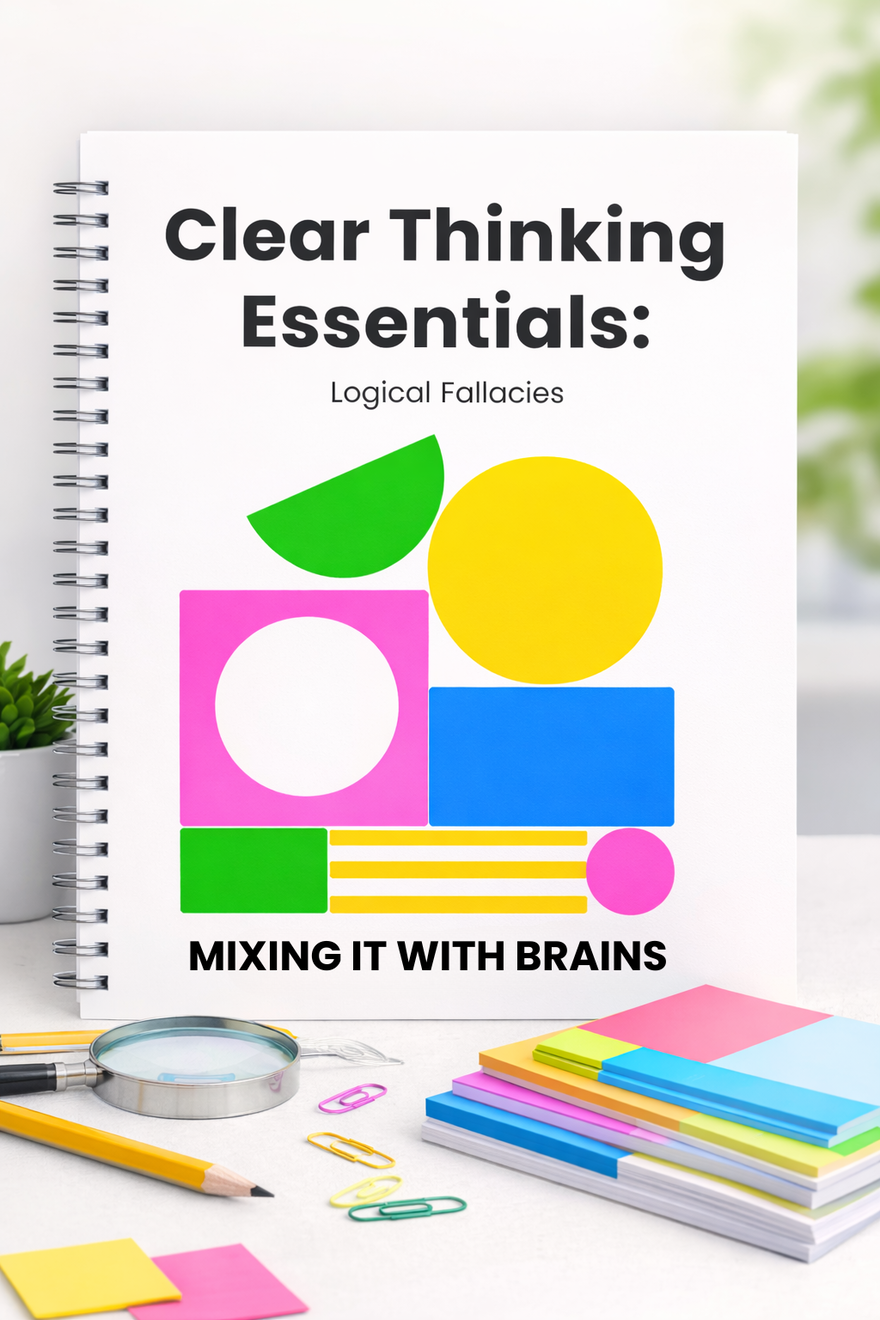
Clear Thinking Essentials
A 36-week, open & go, logical fallacies curriculum for families.
- By week four, they spot their first fallacy in a TV commercial or book.
- By week twelve, they're using terms like "begging the question" without prompting.
- By week twenty-four, arguments are shifting away from emotion.
- By the end of the year, they've learned a new way of thinking, not just a vocabulary.
$34.00. Instant PDF download. 36 weekly lessons.
Manipulation: A Logical Field Guide
16 ways you're being moved before you've had a chance to think.
- The five red flags that should make you pause and think
- Sixteen of the most common tactics, each in plain language with real-world examples
- Questions to ask yourself to discern honest mistakes from manipulative arguments
Enter your email and we'll send it straight to your inbox.

I know what you're thinking:
"I haven't studied logic myself."
You don't need to. Everything you need is on the page. Most parents tell me they're learning right alongside their kids.
"My kid hates worksheets."
Same. That's why there aren't any. Every lesson is built around story, conversation, and questions.
"My ten-year-old is too young."
Not true. Most logic curricula wait until high school, but by then it's too late to close the transfer gap. Kids who start in upper elementary have years to practice before peer pressure heats up and they enter the chaos that is online discourse.
"We barely have time."
I'm right there with you. The program is one short lesson a week. 10 to 15 minutes max. It's flexible, so you can skip a week, or do it every other week. There's no falling behind.
My son stopped mid-sentence at dinner and said 'wait, that's an ad hominem.' My husband and I just looked at each other. This is doing exactly what I hoped it would.
The lessons require zero prep on my part, and are short enough to discuss over dinner. I appreciate how simple and approachable the language is. When online personalities claim this or that and their argument feels a little fishy, I've actually used the reference guide for my own benefit to help me sift through what I'm reading.
It has been a wonderful addition to our logic program. Lauren has created an approachable, open-and-go resource that is informative and suitable for a wide range of ages.
I'm learning alongside my kids and we've really been enjoying it. Love the format this is in.
This is great in our morning time loop. Quick, easy, and effective. My girls actually ask for it. Highly recommend for anyone who wants a logic curriculum without the overwhelm.
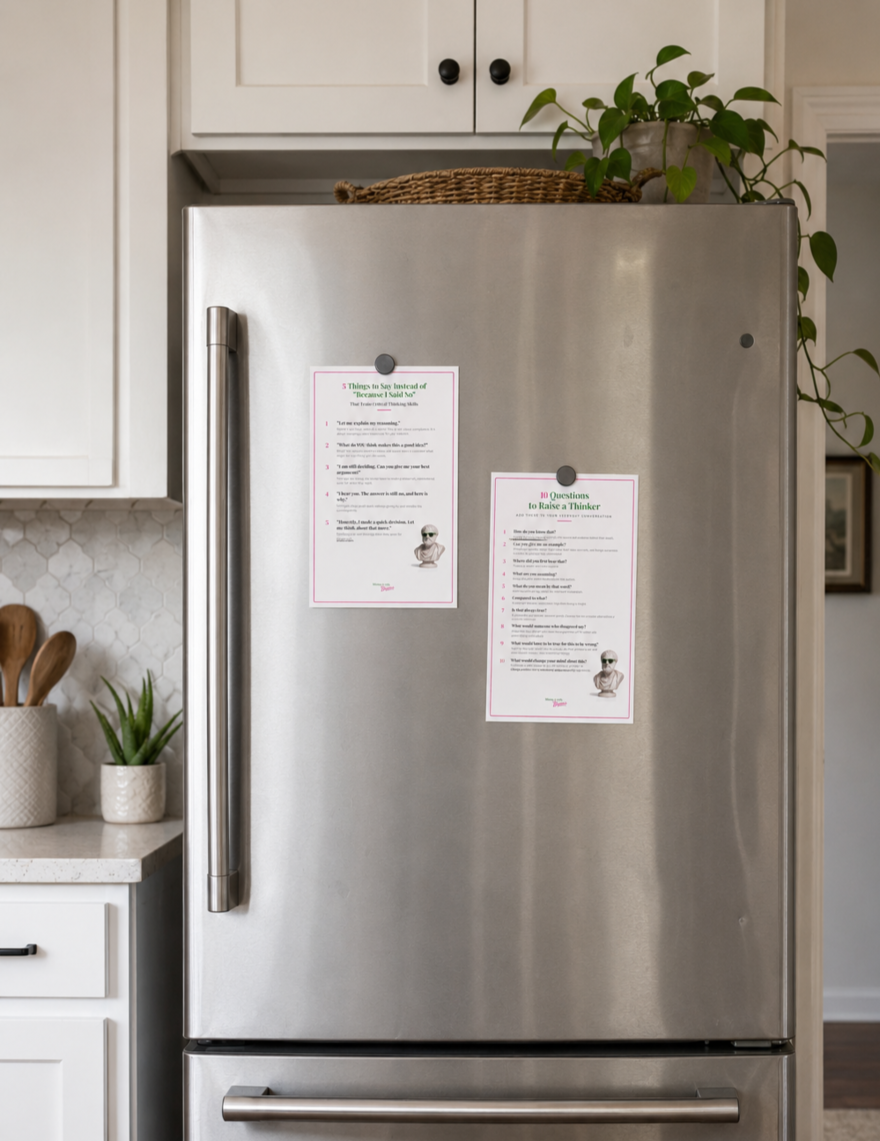
Two free printables for your fridge.
Tools for the next conversation you have with your kid.
10 Questions to Raise a Thinker.
The questions to ask in response to what your kids tell you. The ones that turn ordinary moments into critical thinking practice. Small questions, repeated, that train your kids to pause, examine, and reason before they react.
5 Things to Say Instead of "Because I Said So."
Quick reframes that train your kids to think through their own choices, without giving up your authority as the parent.

I'm Lauren.
A few years ago, I was overwhelmed, watching the world get louder, feeling less and less equipped to raise kids who could stand up in it. I wanted to think more clearly myself. To stop being so easily manipulated. To trust my own reasoning. So I dug in and started learning. Soon after, I started teaching what I was learning to my kids.
Clear Thinking Essentials grew out of that practice, layered over eleven years of studying Charlotte Mason's pedagogy. I'm a teacher at heart; my gift is translating complex ideas into something a ten-year-old can actually use. I built Clear Thinking Essentials because critical thinking is too rare in today's world and I believe kids need these tools much earlier than we typically give them.
I'm so glad you're here.
Good Questions, Frequently Asked
What ages is this written for?
The curriculum is written to be accessible for students as young as 10, but families have used it successfully all the way through high school. The examples are drawn from everyday life, so they land well across a wide age range. Older students especially enjoy the deeper discussions, and plenty of parents have told us they're learning right alongside their kids.
How is each lesson structured?
Each lesson follows a four-step discovery flow. First, your student reads a realistic scenario and tries to identify what's wrong with the reasoning, before they learn anything. Then they meet the fallacy by name and definition. Next, they learn why people use it and where it breaks down. Finally, a second example reinforces the concept and they narrate it back in their own words and create their own example. The discovery-first approach is why these concepts actually stick.
How much time does each lesson take?
Most families spend about 10 to 15 minutes per lesson, depending on how deep the discussion goes. Some keep it quick as part of a morning basket. Others let it turn into a longer family conversation. There's no pressure either way.
What kind of assessments are included?
No multiple choice. Students identify fallacies in realistic conversations, just like they'll need to do in real life. Short assessments come every four lessons, with cumulative reviews every twelve. Complete answer keys with detailed explanations are included, and they double as discussion starters.
Do I need a background in logic to teach this?
Not at all. The curriculum is completely open-and-go. Everything you need is on the page: the scenario, the definition, the explanation, and the answer key. Many parents tell us they've never studied logic and they're picking it up just as naturally as their kids are.
Will my kids need to do a lot of writing?
No. Most of the work is reading and discussion. Students narrate what they've learned in their own words (a Charlotte Mason hallmark) and create their own examples, but the curriculum is designed to be more spoken than written, especially for younger students. You can flex it up or down depending on your child's comfort with writing.
Can I use this in a co-op setting?
Absolutely. The lesson structure works well for group discussion, and the assessments are great for collaborative learning. You could easily assign the initial scenario as a group activity and let the discussion unfold from there.
Is this a specifically Christian curriculum?
It's designed with Christian homeschool families in mind, and some examples touch on faith-related conversations, but the logic skills themselves are universal. Any family that values critical thinking and wants to protect their kids from manipulation will find this useful.
What if my student struggles with a lesson?
That's completely normal and actually part of the design. The lessons are sequenced from simple to complex, and the discovery approach means students are supposed to wrestle a bit before the answer is revealed. If a fallacy doesn't click right away, the cumulative reviews circle back to reinforce earlier concepts. Progress, not perfection, is the goal.
Can I see a sample lesson before buying?
Yes. Lessons 1, 2, and the first Logic in Practice are free to download. You'll see exactly how the structure works, the tone of the writing, and the kind of conversation it sparks before you commit.
If you want to raise kids who can think, you're in the right place.
A curriculum that respects your kid's intelligence and your time. We're continuing to grow with new free resources, articles, and curriculum offerings on the way. Join the email list and stay up to date.
No spam. Just good thinking.